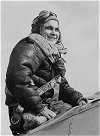
| From Combat
Diary - Edward Beaty
|
|
Updated: 11/25/2004 |
| Brunswick Date: 11 January 1944 |
Return to Chronology of the 447th |
| "Mission
generally snafu, but accomplished." Lt. Edward Beaty |
|
|
Mission Commentary MISSION #7 Between the hours 0740 and 0804, 11 January 1944, 21 A/C of the 447th Bombardment Group (H), "A" group, took off. Group assembly was approximately as briefed, except that bad weather conditions made the assembly very difficult. Because of bad weather, A/C 206, pilot Lt. J.M. Hodges and A/C 127, pilot, Lt. J.A. Stenvig lost the formation. Being unable to locate the formation they returned to base. A/C 095, pilot, Lt. A.S. Heed, lost #1 engine and returned to base. Lt. M. Putnam, in A/C 146, unable to locate the formation, joined formation with the 305th Group and proceeded to the target. The rendezvous with the Wing was extremely difficult because of bad weather. However, the 447th did make the rendezvous and proceeded in Wing formation to the target. 447th Group "A" reports seeing very few friendly fighter throughout the mission. All A/C of 447th "A" group returned safely to base. At the IP, 447th "A" peeled off and made a visual run on the target. The leader reports weather having been CAVU, and target identification easy. Having completed the run, 447th "A" turned as briefed to the Rally Point, At that time the leader tried to locate the 94th Group. He could not identify it but did see the 390th Group, alone and leaving the target. Knowing that the 94th Group had turned for a second run, and having dropped his bombs, the leader did not try to rejoin the 94th Group, but joined in low position with the 390th Group. Strike photos show excellent results on primary target on Brunswick. Direct hits appear to be on MPI from smoke observed. Smoke from bomb bursts completely cover 2 of 3 sub-assembly plants and partially on the third. E/A were observed at various points along entire route in and out from the target. Attacks were not pressed home. Main concentration of E/A were at Rally Point, target, and Dummer Lake. Preliminary claims for this group are 2 E/A destroyed, 4 probables, and 2 damaged. MISSION #7 Between the hours of 0712 and 0803, 11 January 1944, 15 A/C of the 447th Bombardment Group (H), "B" group, took off. Group assembly was approximately as briefed. Because of poor visibility, ships 095, 165, 225, and 148 could not find the formation and returned to the base. Two other ships, A/C 161, pilot, Lt. W.H. Johnson, lost number one engine and returned to base and A/C 096, pilot, Lt. J.G. Jellison reported that oxygen dropped from 375 lb to 100 lb on pilot's and navigator's system necessitating his return just before reaching the channel. The rendezvous with Wing was approximately as briefed with this Group taking position as top Group. Group leader Lt. Col. C.H. Bowman with pilot, Lt. H.A. Jarrel in A/C 107 is missing and right Wing leader, Maj. C.L. Elder with pilot, Lt. M.L. Chardi, in A/C 217 reports taking over lead on call from Col. Bowman. Later Col. Bowman called about taking over lead in a silver ship but in the poor visibility this was not possible and 9 A/C stayed with Maj. Elder. Two of these turned back. With 7 A/C Maj. Elder joined his formation to the 96th and bombed their target dropping incendiaries at the proper interval after they had dropped their GP's. Very little flak was encountered and the formation was not attacked by any fighters. Group leader reports observing 2 JU88's attack another Group flying directly behind the 96th Group. Leader left the formation at the English coast and landed at this base. Six A/C returned with him when the 7th ship left the formation. This leaves 3 A/C unaccounted for. Lt. Col. C.H. Bowman in A/C 107 and Lt. C.L. Hickey in A/C 082 are still missing. Lt. H.E. Fouts in A/C 842 came down in the North Sea and all members of the crew have been rescued and are now at Great Yarmouth Naval base. "B"Group (continued) 2 A/C of this Group bombed the primary target. Results. unobserved. Nieburg believed hit by one A/C with good results. Other A/C in this group bombed on PFF from 96th Group. Believe area bombed to be in vicinity of Rinteln or Minden. |
Combat Roster
Details provided by Iver G. Igelsrud
| The 447th put up a total of
thirty-six aircraft for this mission in two groups. The 447
"A" group (21 ships) was slated to be the high group of the 4B
CBW. The 447 "B" group (15 ships) was slated to be the low two
thirds of the low group in the 4B CBW.
A Group
High
Low
B Group
High Squadron, Low Group, 4A Wing
|
|
NO STRIKE PHOTO AVAILABLE |
From Operational Charts (Pictorial History of the 447th Bombardment Group 1946)
| Mission No. | 7 |
| Mission | BRUNSWICK |
| Date | JAN 11 |
| Field Order | 129 |
| A/C Airborne | 36 |
| A/C Dispatched | 29 |
| A/C Attacking | 27 |
| A/C Failing to Attack | 2 (Mechanical) |
| Bombs Dropped | |
|
No./Type |
170 GP 372 Incend |
|
Tons |
61 |
| Result of Bombing | Excellent |
| Bombing Altitude | 21,000 |
| Time of Take Off | 0710 |
| Time of Landing | 1445 |
| Position in Combat Wing | 447 "A"
4CBW LOW 447 "B" 4CBW HIGH |
| Group Leader | Lt. Col. C.H.
Bowman Maj. C.L. Elder Maj. F.M. Newman |
| Confirmed Claims on E/A | |
| Destroyed | 3 |
| Probable | 5 |
| Damaged | 4 |
| Aircraft Lost | 2 |
| #107 Lt. H.A.
Jarrell (708) #082 Lt. C.L. Hickey (710) |
|
| Casualties | |
|
K |
0 |
|
W |
0 |
|
M |
20 |
| A/C Battle Damage | |
|
Maj. |
0 |
|
Min. |
6 |
| Other Data |
| From Combat
Diary - Edward Beaty
|
| From Combat
Diary - Sgt Harley Tuck
Rattlesden January 11 Tuesday We got up at 7 o’clock this morning, had roll call in the officers barracks at 8:30. Afterwards all of us went back to the barracks to get ready to go to town. I walked down to operations and got the passes. Crew #5 left at noon by G.I. truck from the mess hall. We didn't have to show our passes. We got to Stowmarket at 1230, caught a train for Ipswich after waiting 15 minutes. It took 20 minutes to go to Ipswich about 17 miles. As soon as we hit town we got beds in A.R.C. got supper there and went to a show. Mac went to a dance instead, getting to bed at 11. The trolleys in this town are as modem as anywhere, good service too. Most of the people seem pretty friendly, contrary to what most of the fellows say. The first impression of the town gives us a good impression of things. Gene + Dill went to London to spend their passes. January 12 Wednesday At 8 the four of us got up and had breakfast at the A.R.C. Service Club. It wasn't a bad breakfast, stretched sausages, potatoes, bread toast butter and jam. Afterwards we went out and bought souvenirs, pilots caps and squandered money in general. I spent about £10 for a necklace, brooch and purse, but they are all well made, and very pretty. I think I'll send the brooch to Mom, purse to Lois and necklace to Alice. I guess the jewelry is pretty expensive for the Britishers but the Yanks spend their pounds like water. After lunch the four of us started walking to see the town. We went thro a park with a big pond filled with Mallard ducks + geese. Really beautiful. On the grounds was a mansion that was an art gallery and very old domestic furniture dating back to 13th century. We found another museum and went thro it in a half hour when 2 days wouldn't have been enough time. Natural history, zoology and gun collections filled most of it. A show finished up a swell day. B 11 January 13 Thurs. M.D. and I got up at 7, took a shower and shaved, Fred and Mac got up at 8:45. Soon afterward we went to the A.R.C. Service Club to get breakfast. M.D. and I went off shopping while waiting for the two to finish their coffee; stopping at a jewelry store. Met them at the train station, leaving at 1015, getting to Stowmarket at 1045 where we met the rest of the crew, including the officers back from London. After waiting a while we got a ride to the base in the mai1 truck. A class from 330-530. P.W.+ naval ident. Charlie Harris had to ditch on the last mission when Col. Bowman + Jarrel's plane blew up. Harris and crew had a rough time: the ship broke up, sank in 30 sec. but the whole crew got into boats O.K. The R.O. got an S.O.S. off. 15 min. after landing a Hudson circled, 3 hrs later they were picked up by the Limey coast patrol. All of the fellows suffered from exposure and shock. C. Harris says he's going to quit flying. B 10 |
|
OAK LEAF CLUSTER TO SILVER STAR "CHARLES H. BOWMAN, 0-21994, Lieutenant Colonel, Army Air Forces, United States Army, Missing in Action). For gallantry in action, while serving as Pilot of a Flying Fortress on a bombardment mission over Germany, 11 January 1944. Colonel Bowman had been assigned to lead a group formation, but due to a mechanical failure he was forced to return to base and secure another airplane. As a result of this, he was only able to make contact with two other planes of his group and with them, joined another unit. When the first bombing run failed, Colonel Bowman lead his element over the target a second time and bombed it with excellent results. After leaving the target area, the formation was viciously attacked by hostile fighters and a running battle ensued that lasted for an hour. Just prior to re-crossing the enemy coast, his aircraft was hit by a rocket, which traveled through the entire length of his plane, setting it afire. As the flames enveloped his whole plane, Colonel Bowman maneuvered it out of the formation so as not to endanger other aircraft and appeared to be trying to maintain level flight in order that his crew might have the chance to bail out. His gallant actions on this occasion set an inspiring example for others and uphold the highest traditions of the Army Air. Forces." 447bg.com reference: B0558-0932 |
LOSSES
| A/C 42-31082 (MACR No. 2512) | ||
| Pilot | 2Lt Claude L. Hickey | POW |
| Copilot | 2Lt Justin W. Kegley | POW |
| Navigator | 2Lt Jerome G. Moskowitz | POW |
| Bombardier | 2Lt Vernon D. Devitt | POW |
| Top Turret | T/Sgt Joseph Rokow | POW |
| Radio Operator | Sgt Wade E. Hampton | POW |
| Ball Turret | S/Sgt John J. Roth | KIA |
| Left Waist | Sgt Irving Gitlitz | POW |
| Right Waist | Sgt Robert E. Schooling | KIA |
| Tail Gunner | Sgt Johnnie Deerr Jr | POW |
| A/C 42-31107 (MACR No. 2513) | ||
| Pilot | Lt Herschell A. Jarrell | KIA |
| Copilot | Lt Charles H. Bowman | KIA |
| Navigator | 2Lt John R. Cole | POW |
| Bombardier | 2Lt Thomas M. Tate Jr | KIA |
| Top Turret | S/Sgt Eugene L. Landry | POW |
| Radio Operator | S/Sgt John R. Smither | KIA |
| Ball Turret | Sgt John M. Harrison | KIA |
| Left Waist | Sgt Alphonse L. Rossetti | KIA |
| Right Waist | S/Sgt Raymond Wilson | KIA |
| Tail Gunner | 2Lt William Zurynetz | KIA |
| A/C 42-37824 (No MACR) |
| Lt. Richard E. Fouts and crew; ditched in North Sea, entire crew rescued and returned to base. (for crew list see below) |
From the Public Relations Office at Rattlesden:
| AN EIGHTH AAF BOMBER STATION, England --
"Miss Boo" was one of the many
Fortresses that took part in the large Eighth Air Force bombing assault
on the German target of Brunswick on January 11th. "Miss Boo"
turned on the I.P. with the formation and made one run over the target.
The formation started a 360 degree turn and it was in this turn that a
large numbers of enemy fighters concentrated their attacks on "Miss
Boo." Fourteen ME110's came in from the right and ten JU88's from
the left and turned in towards the tail. They shot their rockets first
and the air around the Fortress was filling with bursting rockets. Five
rockets in succession burst just underneath number three engine and it
caught fire. The first wave of ME110's turned away and the JU88's
continued on in followed by four ME110's that came in high on the
tail. |
If you have additional
information or personal recollections of this mission,
Please let us know!
Any commercial use or republication of
these materials
requires the explicit written consent of the contributors.
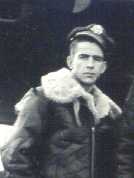 Briefed
at 0400 a.m. Target Brunschweig. Fighter assembly plant. Flew Lt.
Kaffin's 160, "Mickey." Take off at 0710. Scheduled to fly #8
position high squadron. Had difficulty forming at 17,000 ft. Weather
lousy. Everything was mixed up. Headed out over North sea with only six
ships. Finally formed as low squadron flying #2 position. Bombed through
overcast. Incendiaries 38-100 lbs. Group attached to dropped HE's Bomb
doors would not retract. Alt. 21,000 ft. light flak. Not much fighter
opposition. Ball gunner got a crack at two Ju 88s who made a pass at us.
8 hr. mission. Lost Col. Bowman, Lt. Hickey, and Lt. Kegley. Kegley a
P-47 man and a real buddy. Hope he got down okay. Other groups took an
awful beating. Total losses 59 aircraft. Got over 100 Jerries. Did a job
on several of their aircraft plants. I've been awfully lucky. Mission
generally snafu but accomplished. Three out of five.
Briefed
at 0400 a.m. Target Brunschweig. Fighter assembly plant. Flew Lt.
Kaffin's 160, "Mickey." Take off at 0710. Scheduled to fly #8
position high squadron. Had difficulty forming at 17,000 ft. Weather
lousy. Everything was mixed up. Headed out over North sea with only six
ships. Finally formed as low squadron flying #2 position. Bombed through
overcast. Incendiaries 38-100 lbs. Group attached to dropped HE's Bomb
doors would not retract. Alt. 21,000 ft. light flak. Not much fighter
opposition. Ball gunner got a crack at two Ju 88s who made a pass at us.
8 hr. mission. Lost Col. Bowman, Lt. Hickey, and Lt. Kegley. Kegley a
P-47 man and a real buddy. Hope he got down okay. Other groups took an
awful beating. Total losses 59 aircraft. Got over 100 Jerries. Did a job
on several of their aircraft plants. I've been awfully lucky. Mission
generally snafu but accomplished. Three out of five.