|
RAID ON BERLIN |
 |
|
Updated: 10/30/2004 |
|
RAID ON BERLIN |
|
P R O L O G U E
|
The following story, "Raid on Most of us met each other
for the first time in the Classification We enjoyed a casual
friendliness from our first meeting which helped us function smoothly.
On the ground, when we were not in classes, we were a group of young
guys enjoying each other in good fellowship. In the air we were, in the
speech of the day, sharp in every context of the word. Our crew was
serious about our training as we learned to perform our assigned duties
to the best of our abilities. There was only one objective in every mind
day and nights when we had completed our missions we were all coming
home safely. This was never expressed as a hope; we stated it as a fact. The crew operated as a
polished unit, and, if there were any disquieting divisions, they were
left behind "for the duration" of the war. We ate together, we
traveled together, we sang together, we went on On every mission we flew
under fire and brought our plane back peppered with holes of assorted
sizes. No enemy fighter aircraft ever attacked us, I am happy to report.
All of our wounds, personal and to the aircraft, were inflicted by
antiaircraft fire from the ground. I strongly believe that the presence
of so many trained competent gunners at their places willing and
extremely able to use their guns with great effect was the deterrent to
attack from fighters. Each of us was made to
feel more secure knowing that every one of us was ready and willing to
fight for all of us. It Worked. |
||
|
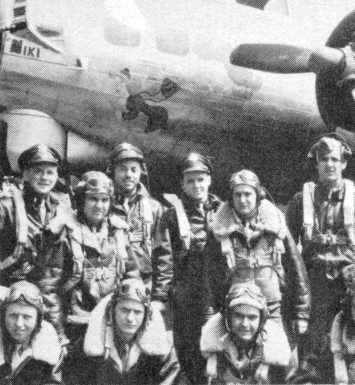
D E D I C A T I O N This story is gratefully dedicated to the men who flew that mission. They are the inspirations for writing the recollections.
|
||
|
At midnight
the Charge of Quarters turned on the lights in our hut. Seven pairs of
tired eyes looked up at him. He began to read, "Lt. Vorhees' and Lt.
Altman's crews - briefing will be in forty-five minutes." We had had
but four hours sleep, and we put on our clothes while more asleep than
awake. "How much gas today, C.
Q.?" "Well, sir, the Tokyos
are topped off." A long sigh arose from the
whole barracks, then one voice made of seven said, "Big B, sure as
hell!!" On our way to breakfast
the half-haze, half-fog morning mist practically concealed the men just
ahead of us. The mess hall looked cheerful and warm after the cold of
the early English morning. Faces equally as tired as my own looked up
from the tables. Only here fresh eggs were served, nowhere else in We gulped down our
breakfast and coffee, and then we rushed to the trucks waiting outside
to take us to the briefing room. Little red glowing coals all around
told us we were not alone. The cigarettes were the only lights in the
trucks. The bumps on the way to the briefing room woke even the
sleepiest of us. Benches were lined in two
rows on either side of a huge Nissen hut that was the briefing room.
There was an aisle between the two rows for the projection machine. A
screen was hanging before the map. Concealed behind the screen was our
target for the day. We were all seated when
the Group Commanding Officer came in. Someone yelled, "Attention!"
and we stood until he reached the front of the room. "Please be seated. Let's
get this target today, and we won't have to go back." He took his
chair, and the briefing got under way. Altogether too slowly the
screen was raised, and the map was exposed. Colored pieces of yarn
charted our courses in and out of The screen was lowered
after the Navigation Officer briefed us on the courses. We were warned
not to leave the course being flown except in emergencies. Next, the Weather Officer
took over; his was the most complete data in any theatre of operations.
The weather reports were called in by aircraft sent over The navigators were given
wind velocities at all altitudes by the Navigation Officer, and then he
synchronized our watches. "Coming up on 0147 in 30 seconds - 20
seconds - 10 seconds - 5 - 4 - 3 - 2 - 1, hack!" Now all our watches
told the same time. From here on, Intelligence
took over. Detailed maps and charts of the target areas were projected
on the screen for us. Photographs, perhaps only twelve hours old, were
also shown and discussed. The main point of bomb impact, called the
M.P.I., was marked with a big red cross in the center of The Intelligence Officer
briefed us, "There are at least five hundred heavy guns and a number
of mediums in "You'll be over water
for some time. Keep your eyes open for ship movements. If there are
convoys on the Autobahns, let us know that too. Keep your eyes open,
especially for traffic on the Dutch Canals. See you when you get back -
Good Luck!" Everyone filed out to his
locker, and the Bombardiers got their final briefing on the target. The
bomb load was discussed and dropping interval selected for maximum
effect. The usual horseplay was in
progress in the locker room. While someone playfully helped you undress,
you tried to dress. First, I donned my Physical Training clothes from
cadet days then, my flying suit. Next came my leather jacket and fur
lined boots. The Mae West life preserver and the chute harness went on
last. We carried out our chute packs, leather helmets, gloves, oxygen
masks and Flak helmets. One of the co-pilot's jobs
was to get our rations for the flight. As I walked over to pick up our
share of chocolate bars and gum, "Roger!" After that, I checked in
my wallet and papers with the Intelligence Office. Each man had an
individual bag and a receipt. "I'll be back later for that" was the
usual comment. And, "we'll be expecting you" was the reply. The
smile that followed helped convince even the most doubtful. For those who desired it,
the Chaplains said mass and gave Holy Communion. Many attended a little
service before take off time. The trucks were waiting
for us outside, and the drivers were yelling "Low numbers here!" or, "High here". Ours was a high number, so we piled our equipment on
the "High here" truck. On the way out to our planes a quiet voice
said, "What a hellova way to make a living!" We could feel, rather
than see, the smiles all around us. Briggs, the Co-pilot of
the crew in a hut near ours, was being ribbed. His pilot was having a
grand time until Briggs said, "Fellows, I wouldn't want it to be
generally known, but I have a landing to my credit!" Laughery was
quiet now. Pilots let Co-Pilots land only rarely - when they are unable
to do so themselves. "Here is fifty-four"
yelled the driver. "Let's go, Mac." Altman and I jumped off,
and the rest of our crew hit the pavement with us. There stood the love
of our lives, a B-17G called "The Bouncin' Baby". She was all metal
and cold as ice, but we loved her. She has taken us out and has brought
us back home before. She had personality. Her name came from the habit
of bouncing back home from the continent and because she was a stubborn
little gal to land. She was our baby. "How is she today, Clark?" "She's in fine shape, sir." Nothing more was asked.
That "fine shape" stood for long hours of work by flashlight in the
blackout. It assured us we could depend on our plane. Combat crew chiefs
loved their planes and sweated out every mission as much as we who flew
them. There was still some time
before we started the engines, so we talked over the mission with the
gunners. All of their guns had been checked and long belts of ammunition
were ready for instant use. "It's pretty foggy -
you'd better flash the lamp for us this morning, Marvin." With a brief "Okay",
Marvin crawled back to his tail gunner position and readied the lamp for
use. His job was to flash a red light so that other ships behind us
wouldn't taxi into our tail in the fog. Everyone was now aboard,
so Altman and I took our seats in the front office. We went through our
check lists, then: "Start One!" The centrifugal starter
began to whine. When it reached its highest pitch Altman ordered, "Mesh!" It started. The other three engines
were started in order. As they spewed smoke and fire and sputtered to
life they shook our plane. We felt we were really on our way to
Jerryland. The engines had started easily and checked perfectly, as
Clark
said they would. Our engines were warmed up, and we were ready to taxi.
The squadron leader passed our hardstand, and we fell in line. We went
around the perimeter track to the takeoff runway. All along the track
other planes were getting ready to taxi out. Final checks were made
just before take-off. Altman and I checked the magnetos, then – "Co-pilot to right waist
- checking flaps." "Flaps coming down - all
the way down - coming up - they're okay", Chuck, the engineer
reported. "Report on the crew, Chuck." "Everyone in the radio room, sir." "Roger." We were now set for
take-off, so we taxied out to the run- way. Engines roared as they were
run up, and the brakes were held. "Better give me some flaps, Mac.
She's loaded today." The flaps went down half-way. Thirty seconds after the
leader was airborne, our brakes were released, and the Baby leaped
eagerly for the take-off run. For what seems ages in a bomber pilot's
life, the loaded plane rushed down the runway. At last we were airborne
too. "Wheels up!" The fog was still thick,
so the navigator guided us on instruments for the squadron assembly. "Pilot to Navigator." "Go ahead, Herb." "What's the first course, Ted?" "Fly 230 for two minutes." "Roger." First one then another
course was flown, and, at last, at 7,000 feet, we broke through the top
layer of clouds. The sun was peeping over the horizon; day was
beginning. All over the sky were other bombers getting ready for the
same job. Flares were being fired from lead ships of the formations. The
radio buzzed with activity. "Gunblue One, this is
Lowland K-king. Will you fire a flare? Over." "Roger, K-king. Gunblue One circling left, firing flares. Do you see me now?" "Roger, Gunblue One.
K-king joining right away. K-king out." As we circled for what
seemed to be hours, other planes gained altitude and joined their
formations. Turn about was taken on the controls while the last
cigarette was smoked before the oxygen masks were put on. We continued
to climb. Finally, "Co-pilot to crew, we're at 12,000 feet. Put on
your masks, acknowledge." Familiar voices with a
different tone due to speaking into the masks checked in: "Tail, Roger!" "Waist gunners, Roger!" "Ball turret, Roger!" "Radio, Roger!" "Top turret, Roger!" "Navigator, Roger!" "Bombardier, Roger!" "Co-pilot to tail, are you all set back there, Marvin?" "Roger.Say, Number Six is trailing." "Okay. Keep an eye on
him in case of trouble. How are you Dow? Is it cool in the ball today,
J.J.?" "It's cool alright. I
have my suit turned on already." "Keep an eye on Arkey in
the radio room, Chuck. And you and Campman check each other's masks
there in the waist." "Roger! Will do." The Co-pilot usually
joined the pilot in monitoring radio for most of the mission, so – "Co-pilot to Bombardier,
they're all yours, "Okay, Mac." I took over the controls
and gave Altman the high sign that everything was set. He had been on
radio and missed the intercom chatter. The altimeter rose
steadily as we climbed on course from "Navigator to crew,
we're leaving "Ted, let us know five
minutes before we hit the enemy coast. We've got to put on these Flak
Suits." "Roger, can do, Herb." The formations droned over
the channel. First, we flew north and then, East. We were to enter "Five minutes to
coast-in, better put on the suits." Turns were taken on the controls
as Altman and I put our suits and helmets on. The helmet and masks
covered all but our eyes, and we smiled at each other through the masks. As the coast came into
view our P-47 escort joined us. Boy! Did those buzz boys look good to
us! Flak was reported low on the right side of the ship. Intelligence
wasn't wrong. It was far below us and didn't cause any excitement. The Dutch border was
passed, and Der Vaterland was beneath us now. The first escort left and
the P-38's picked us up. Soon, they too were replaced, and the P-51's
were taking us in to the target. Suddenly, the sky over the
target now directly ahead of us was pockmarked with polka dots of black
smoke. Jerry was awake! Brother, was he awake! This was it! We were on the bomb run
before we knew it. The bomb bay doors opened; the throttles were advanced.
The Bombardier kept up a steady - - "Flak - -9 o'clock
low." "Flak - -10 o'clock
high." "Flak - -3 o'clock
level." "Flak - -10 o'clock
level." "Damn! They're throwing
it up today!" The sweetest words in the
English language finally came over the interphone, "Bombs Away!" The
bomb bay doors were quickly closed, and prayers were quietly said to
help us to leave the Flak area safely. Bursts covered the sky in all
directions. Our "Flak - -11 o'clock
low." "Flak - -9 o'clock level." "Flak - -12 o'clock low." "They're tracking us!" "Flak - -12 o'clock higher!" "Flak - -12 o'clock higher!" "Better pull her up, Herb." "Flak…" There was a terrible
explosion, and the Baby raised her nose above the horizon. I could smell
the smoke from the Flak shell, even through my mask. Looking down in the
nose I saw First Aid kits were called
for and passed forward, then the interphone was silent. Altman and I
looked at each other in a strange way. One of us had been hit! There are
times when one forgets all about himself - I looked down helplessly
while Ted doctored a dirty cut in All at once he moved! Yes!
It was true! He was Alive! "Thanks, God, thanks." Now the tears were
for .joy, he was still alive! The leg was bandaged, and he asked for his
mike to be connected. There was a wonderful voice that said, "Well, I
have a medal you guys haven't, I've got the Purple Heart." Good old All the crew wanted to
know how he was. "He's okay" said the Navigator, "Let him rest, I
just shot him full of dope. He has a wound in his leg, the Flak was
stopped on his stomach by the Flak suit, and it knocked him out. Let him
sleep, the dope is beginning to act." An uncommonly long time
had elapsed in a few minutes. We were out of the Flak area and homeward
bound! It was great to be alive! The wind coming in through the hole in
the nose plexiglas was not so irritating after all. Coming home, Flak was
reported over many German cities - just to let us know. We didn't care
today for we had dropped our bombs on target. Soon the Navigator
reported, "We'll leave the coast in twenty minutes." "Roger. Say, Ted, get me a course home - we're going in early." "Okay, Herb." The channel was under us
again. Permission was asked to leave the formation, and it was granted.
As we left the group, the throttles were pushed forward to get The Navigator's course was
true, and soon the field was below us. As we landed, Jones, the top
turret gunner, fired red flares to tell the tower we had a wounded man
aboard. The ambulance could be seen going to the end of the runway to
pick him up. We cut our engines near
the ambulance, and the Flight Surgeon came aboard. He congratulated Ted
on his good First Aid work as he examined the wounded leg. As a
stretcher was taking him away, The engines were started
again, and we taxied to our hardstand where we were met by the ground
crew. The other planes flew over the field before landing. Eyes strained
to count them – - "They're all back!" A truck carried us to the
briefing room for interrogation. The Intelligence Officer asked us many
questions in order to get a complete report. The number of fighters,
methods of attack, amount of flak, accurate or inaccurate, all of these
interested him. One crew reported some barges on the Dutch Canals. That "Hot News" was wired to Headquarters for immediate action. We ate cakes and drank hot
coffee served by the Red Cross. On the other side of the room Scotch was
available. Our crew didn't drink today - we had our reasons. The mess hall people were
expecting us. It was dark but they had kept our food warm for two extra
hours. Their smiles told us they were glad to see us back. The same stew
and potatoes were better than ever before. Going back to the hut, we
discussed the day's mission. We were all glad to be back alive, but we
were sorry A small prayer of
thanksgiving for letting us all return alive was said in a whisper -
then everything was quiet. |
||
|
On 11 July 1944, the Altman crew took off in
42-102651, Piccadilly Ann II for a raid on Munich. Hit by flak,
unable to keep up with formation, and unable to return to England,
Altman made a forced landing at Dubendorf, Switzerland. The crew
and aircraft were interned.
Jay Ames and Marv Handley had been replaced for that particular mission by Lt. James Davidson and Sgt. Clarence Jost. |
Material on this page is the property of the
contributor,
and may be distributed or republished only by his
explicit consent
For more information, e-mail
E-mailwith any comments or questions about this page