|
From the Public
Relation Office, Rattlesden, 16 March 1944
AN EIGHTH AAF BOMBER BASE,
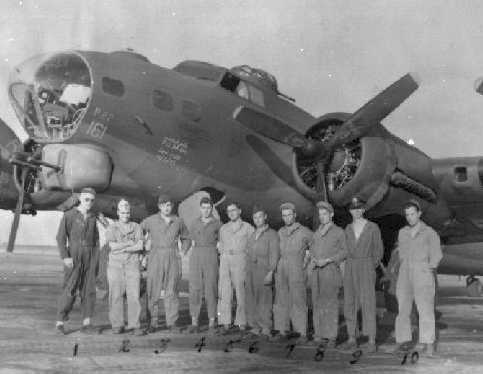
England -- The "Flying Fortress, "Spare Parts" almost
became just that on a recent bombing mission over Augsburg. A shot out
engine, loose prop and leaking oil tanks were a few of the mishaps
encountered by Spare Parts on that day. 1st Lt. William H. Johnson,
23, of Minneapolis, Minn., piloting Spare Parts was flying in number
three position in the lead squadron at 19,000 feet. Upon crossing the
French coast they were not greeted as usual by heavy bursts of flak
which is generally very strong in that area. Noticing this, the crew
members on "Spare Parts" were settling back to enjoy a milk
run when suddenly in the distance they saw their dreams shattered. For
bearing down on the formation were about forty FW190's with their 20mm
cannon flashing orange from the wings, and their machine guns
projecting bright tongues of flame from the fuselage.
"They came in a big mass head-on attack,
smashed right through our Group," said 2nd Lt. Harold W. Whiteley,
23, of Limerick, Maine describing the scene.
"I saw one of our planes low and to the
rear of us fall out of the formation on fire, I saw two chutes before
she blew up," added Staff Sergeant Peter Bartktus, 30, of Lowell,
Mass. On the second attack by the enemy fighters the FW's split up and
came back in attacks all around the clock.
"They came in so close that I could
plainly see the markings on the ships and could even make out the
faces of the pilots," said Staff Sergeant Kenneth L. Zeiger, 19,
of Mishawaka, Indiana. This attack lasted for about fifteen minutes
when suddenly the FW's left. However Spare Parts' escort was not gone
for long for a few minutes later ME109's and 110's appeared on the
scene displaying tactics very familiar to the crew.
"They climbed to our level and lobbed
their rockets at us. I saw ten of them at one time line up and let go
their rockets simultaneously," remarked Technical Sergeant John
A. Higgins, 19, of Kew Gardens, L.I.N.Y.
Luckily for Spare Parts the rockets went high
of their mark. A few of the ME110's, a bit bolder than the rest, came
in very close, did half a roll exposing their armor protected bellies
to our fire. They kept coming in with their guns blazing. However, one
of them made the fatal mistake of getting within range of Sgt. Bartkus'
fifties.
"It was duck soup," said tail
gunner Pete, "there he was right in my sights at six o'clock
level about 500 yards off. I let him have a burst, the plane went into
a loop, then I saw two chutes come out of the damaged plane. It then
started to spin and disappeared under our plane."
By this time Spare Parts had started on her
bombing run, when suddenly number three engine went out. The plane was
vibrating badly and the prop threatened to come off at any moment. Lt.
Johnson gave the order to stand by to bail out. However a few minutes
later the plane wasn't vibrating as badly as before, consequently he
rescinded the jump order. It was impossible to keep up with the
formation so the pilot gave the bombardier orders to drop his bombs
immediately, and that he would try to make it to Switzerland. But the
Jerry fighters had different ideas, every time Spare Parts attempted
to head for the land of the Alps the murderous fire of the enemy
aircraft forced them back on their original course. There was only one
thing left to do and that was to try to catch up with the rest of the
formation.
"Right then we were the proverbial clay
pigeons; we were being attacked by fighters on all sides," top
turret gunner, Technical Sergeant Frank J. Hazzard, 35, of Chicago,
Ill., declared, "and the tail gunner did a wonderful job of
warding off the attacked from both the top and the rear of the
plane."
In order to lighten the load of the ship and
thus increase her speed, everything moveable was thrown out of the
aircraft, flak suits, extra ammunition, even the bail turret was '
jettisoned in a final attempt to increase the speed of the plane. With
its lighter load Spare Parts managed to catch up with her formation,
and from then on the danger of fighters was over. An escort of P-51's
had picked up the formation and was convoying the bombers home.
However, Spare Parts was still having its troubles, the loose prop was
windmilling, causing the ship to vibrate worse than ever.
"I could just see that prop coming off
and flying right smack through our nose but luckily she hold on until
we reached home," said 2nd Lt. William Fancher, 27, of Walton,
N.Y. Back in the waist of the ship still another danger was present. A
leaking oil tank was throwing the black liquid up through the empty
space where the ball turret had been and was covering the waist of the
ship with a sheet of oil.
"All we were afraid of was that our
oxygen system might start to leak and if the oil and oxygen ever got
together we would have been blown sky high, but again fate seemed to
be on our side and the only thing that happened was that the waist
gunner and myself got our faces awfully dirty from the flying
oil," remarked Staff Sergeant Elbert J. Williams, 25, of Kansas
City, Mo.
Safely back at their home station the crew
members of Spare Parts minus a few of her parts were none the worse
for their experience.
|